1. Open wounds
2. The single mom
3. Missing men
4. Times change
5. No divorce
 Written by M.E. Sprengelmeyer, staff writer
Staff photos by Juan Carlo
American servicemen abandoned children
Open wounds
OLONGAPO, The Philippines -- On June 12, millions of Filipinos celebrated the 100th anniversary of their island nation's independence.
But in a one-room, plywood shack in this seaside town, Rose Pedraya
treated it as just her annual reminder of what America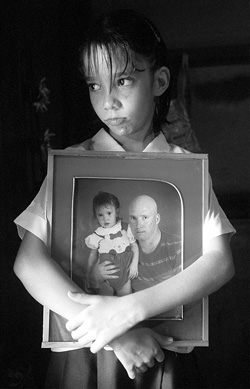 left behind after nearly a century of involvement in the Philippines.
June 12 was the eighth birthday of Pedraya's daughter, Joanne Erika.
Each year when the date rolls around, they wait in vain for a birthday package from the child's father, a Marine once stationed at the nearby Subic Bay Naval Station.
The father is now AWOL -- as are legions of other American servicemen who impregnated local bar girls before the base closed in 1991.
In the area bars, American sailors have been replaced by sex tourists from the United States, Australia, Europe and Japan. But very little has changed for women like Pedraya.
Saying she has no choice, Pedraya still supports her family by working in an Olongapo saloon -- where she flirts with men, trying to get them to buy her "ladies' drinks" at inflated prices.
In the Main Attraction bar where she works, three other bar girls have children abandoned by American fathers. They consider their families the discards of America's presence in the Philippines.
"I wish the base was still here, but I know it's impossible," Pedraya says, explaining how she still hopes an American tourist will sweep her off her feet and take her to the United States.
"I loved him but he didn't love me," she says of Robert, the baby-faced
Marine from Massachusetts who is Joanne's father. "I trusted him but look
what he did to me. I just wasted my time with his promises."
The faces of Amerasian children fill the streets in this former Navy town. Many are offspring of bar girls like Pedraya from the area's leading industry: sex.
Pedraya has two children by different American men she met while
working as a "bar girl" in Olongapo. 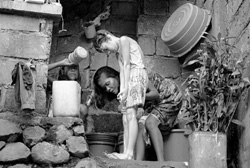
In 1985, she met a 26-year-old Merchant Marine named Darryl while working in a bar called "Showboat." They started dating but he left in 1986 after she was two months pregnant with Dahlia Rose, now 11.
In 1989, the Marine named Robert paid the saloon a bar fine of 600 pesos (about $15) to take her out on a date. She became his girlfriend every time he came into port. In 1991, Joanne Erika was born.
After the base closed later that year, Robert kept up contact for a while, sometimes sending $100 in a card on the girl's birthday. Eventually, Pedraya got a letter saying he married somebody else back in the United States.
The support stopped coming.
Today, Pedraya and her daughters live in a one-room, plywood shack behind a store along the main highway through Olongapo. They cook at a propane stove and carry water up the steps in buckets from a community spigot three houses away.
The children sleep on a thin mat on the concrete floor, or with their mother on a bare mattress that Robert bought for them. He also left an ornate, antique hutch with an inlaid mirror, an elegant piece amid the simple, mismatched furnishings.
Pedraya still blames herself for not being able to hang onto either of the American men.
"Maybe it's my fault because I was young," she says. "I didn't know how to take care of a guy. I didn't know how to cook."
Near a photo of Robert on the wall is Rose's diploma from a school that taught her to be a telephone operator. Because she needed to support her children, she could not afford to take one final certification course to become an operator.
She figures working in the bar will always be her only option.
"Maybe my daughter will be the one to do it," she says of the
modest dream of being a phone operator.
At the Main Attraction saloon, bar girls crowd around a reporter and make sure he writes down the names of their children and the long-lost American fathers.
"I'm just mad about why he stopped the support," said Asuncion "Cora" Abener, 30, who got pregnant by an American Navy man and angered him when she refused to get an abortion.
She works in the bar seven nights a week to pay the 1,700 peso per month rent (about $42) on a one-room apartment a few blocks from the bar. She cannot afford a baby sitter for her 6-year-old daughter Jane, so she leaves her alone in the apartment each night and tells her to run for the neighbors if she needs help.
Like other women in the bar, Abener faces a paradox.
She got pregnant after meeting a man while working in a bar, but now she cannot get out of the lifestyle because she has to support her child and there are few job opportunities in the Philippines.
"If I don't work, I'm not going to have money," she says.
Each day in the bar, women get an allowance of 50 pesos -- or $1.25. After that, they only earn a commission by flirting with men and convincing them to buy "ladies' drinks" costing 50 pesos each -- twice the normal price.
Some women will put their hands all over foreign tourists, trying to massage drinks out of them. In this bar, women are not supposed to go out with men who pay bar fines to the saloon owner, although a man at the door whispers to visitors that he can help if they want to take home a "pretty girl."
No matter what they say or do with customers, the women say they are not enamored with the men. It's just a job.
"It's hard to live to my budget because I have to pay everything,"
said Aida De Los Reyes, 29, who has an 11-year-old son from a long-gone
U.S. Marine.
Some people say Olongapo seems "dead" since the American servicemen shipped out.
In a courtyard outside her tin-roofed shack, 54-year-old former prostitute Nenita De La Vega swings her hips and bats her eyes, showing off moves she says snagged hundreds of sex-starved American servicemen.
She claims she sold her body to 10 men a day from the Subic Bay Naval Station between the 1960s and the 1980s. She was left with five children from five different American customers -- all who since disappeared.
"When I worked in a bar, I make money, money, money. I'm ashamed to tell you how many guys I've had in one day," she says, as stray cats play outside her door and a loose rooster keeps watch nearby. "Americans were crazy for my body before. 'Let's get it on, man.'
"When they declared the bases gone (in 1991), all the girls were
crying," she says, sitting at her kitchen table under a poster of Michael
Jordan. "When the bases were here, people were not hungry." 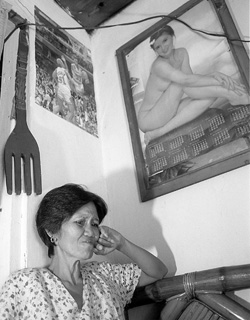
Although the commercial sex scene slumped and had to weather occasional crackdowns by authorities, observers say it has rebounded because of an influx of sex tourists, including some returning American servicemen, plus Australians and Europeans.
Susan Pineda, of the Angeles City women's group IMA Foundation, said the Philippines still invites widespread prostitution because of a lack of economic opportunities and the poor treatment of women in general.
"Though the root problem is poverty, gender is also an issue," said Pineda, an Angeles City councilor who has relatives in Oxnard. "As long as there are men who clamor for commercial sex, it will always be the same."
Social workers know it's pointless to preach to women about leaving the bar scene unless they can show realistic alternatives.
In Olongapo, former prostitutes learn clerical and accounting skills at the Buklod Center.
"We just organize women so they know how to fight for their rights
in the clubs," said Alma Bulawan, 36, a former bar girl who also has an
Amerasian child. "That way, the woman gets to decide if they want to work
in the bars or stop. We don't just tell them to stop because then they
ask, 'Can you support me?'"
Some women are trapped by a quirk of Philippine culture.
Divorce does not exist in the Philippines, so some women are stuck in marriages to American men for life -- even if the husbands disappeared 20 years ago.
That's what happened to 46-year-old Jovite Mission.
She was working in a restaurant in 1975 when she met a 23-year-old Navy man from Ohio, struck up a romance and got married.
They had two children, seeing each other only when he came into port. In 1980, he stopped coming around and even dropped contact with the children, a son, now 23, and daughter, 20.
In 1987, Mission met a man she calls the love of her life, a Filipino cabdriver named George Bernardo. They'll never be able to wed because she's still married to the American.
"Sometimes I hate Americans, but sometimes Americans help me also," said Mission, who peddles clothing and trinkets on the streets of Olongapo. "Before, I was very angry, but now I forget him."
Even though so many Americans have abandoned their Filipina lovers and children, many women still hope an American man will sweep them off their feet.
Since 1898, when America replaced Spain as the colonial power, the United States has had a powerful mystique for the people of the Philippines.
In the saloons, bar girls say they prefer American tourists to the Swedes, Australians, Brits and others who have filled the gap since the sailors left.
After all that has happened, their continued willingness to accept American men is disappointing to social activists who want Filipinas to be independent.
"Of course there is something wrong with our culture," said Madonna Carlos, of the feminist group IMA Foundation. "We're hopeless romantics and we still believe in the Cinderella story."