1. The groom
2. Across the Pacific
3. The bride
 Written by M.E. Sprengelmeyer, staff writer
Staff photos by Juan Carlo
Money can buy him love
The groom
Andy Sikes fidgets with the seat belt stretched to its limit beneath
the rolls of his belly, and stares through smudged glasses at an in-flight
movie. 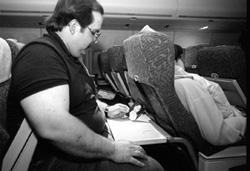
His mind is racing. In just a few more hours, his lifetime of loneliness may come to an end -- or he may have the most expensive heartbreak of his life.
The 34-year-old Colorado truck driver is on his way from Los Angeles to the Philippines, hoping for a first kiss from the fiancée he has never met.
Sikes paid a Texas company $1,500 to introduce him to single Filipinas by mail. He fell in love at first sight when 26-year-old Arlene Moreno sent him a picture from her family's home in a depressed area of Manila.
Over the past year, Sikes sent countless letters and ran up hundreds of dollars in telephone bills, hoping she'll come to know him as a lovable "teddy bear" -- not as the five-foot-nine, 285-pound guy whose obesity got him kicked out of the Navy.
"I'm not slim, trim, make 50K or fit the other types that women are going for," he says in a slow, deep drawl.
He still lives with his mom in Aurora, Colo., has never had a steady girlfriend and has quit trying to ask out American women.
"Some of them politely refuse. I've been laughed at twice, which is not fun," he says. "I've almost given up hope of finding anybody."
Like hundreds of other American bachelors, Sikes has invested his money and emotions in the international matchmaking industry.
Through singles publications and sites on the Internet, companies play on the rejected and promise the women of the Philippines and other underdeveloped countries will accept them -- no matter what they look like.
Some give lists of "mail-order brides." Others, including Philippine Adventure Tours of Ventura, offer tour packages to visit the Philippines and introduce men to potential brides or sex partners.
Critics call it exploitation, not romance. They say the men are taking advantage of poverty in the Philippines, where a $35,000-a-year truck driver like Sikes is considered wealthy.
None of that matters to Sikes, who said his mother, sister and anyone else who wants to question his decision can mind their own damn business.
"According to a book I saw, I'm doing everything for the wrong
reasons," Sikes says. "But the gal who wrote that book never had to go
through what I've gone through."
Sikes paces in the tight corridor in the back of the plane. It is lined with mirrors, and he removes his "Area 51" baseball cap to fix his hair, even though there are still several hours to go in the 16-hour flight to Manila. He leans over and presses his head against the wall.
"If I even thought I was going to get hurt, burned or something I'd regret later, I wouldn't even have done it," he says.
His belly and backside bulge in opposite directions, giving him an oddly-shaped body that stretches the limits of his faded blue jeans and black polo shirt.
He has always been overweight. Ever since high school, all the girls turned him down.
Sikes grew up in the Denver suburb of Aurora, Colo., where he graduated from Aurora Central High School in 1982. He attended a vocational school for masonry, carpentry and mechanics.
His father was an ex-Army man, so the military seemed like a good option. He joined the Navy's Seabees because of his construction background. The Navy took him to places like the Japanese island of Okinawa.
There, he didn't have a girlfriend, but he admits to a little "carousing" with women working in the bars. He leaves it at that.
During the Persian Gulf War, Sikes drove a fuel truck just 14 miles from the Kuwaiti border. After the war, when he weighed less than he does now, the Navy found he had 21 percent body fat and ordered a medical discharge.
Just like the Navy, women back in the United States rejected him.
"Anyone I tried to date in the states was either psychopaths, married or taken E or they just wanted to be friends," he says.
It made him bitter toward American women and especially feminists, who he thinks have destroyed traditional values.
"I want a woman who's going to stay with me and not leave me to forward her own career," he says. "The way I view things, as part of my commitment to the relationship, the relationship comes first."
None of that mattered because he could not find any woman who wanted him.
He started driving a truck in 1993 for a Salt Lake City company, making cross-country runs for weeks at a time.
His rig has almost everything he needs. Leather seats, bunk beds, a television, videotape recorder and a whole box of tapes. What's missing is someone to ride along in the passenger's seat, he says.
"If only she could see what I've seen," he whispers, as other passengers sleep in the darkness.
He talks about the full moon reflecting off a fog bank in Maryland, and dusk in the Southwest.
"Have you ever seen a sunset in Arizona? All the oranges and reds," he says. "I want to be able to show her the things that I've seen."
On one cross-country trip, Sikes picked up a singles magazine at a rest area. He sent $150 to a company whose ad promised a list of women in the Philippines interested in guys like him.
It did not work, probably because hundreds of guys got the same list, he figures. From the ads, Sikes started picking up the stereotype-laced language companies use to describe women of the Philippines.
"The ladies are feminine without being feminist, if you know what I mean," Sikes says. "Once you get to know them, they'll accept you for who you are, not what you can provide."
According to the companies, the women have traditional values, like to be homemakers and, because of the Philippines' Roman Catholic traditions, do not believe in divorce.
That type of stereotyping makes feminists cringe.
"He wants a slave, not a wife," said Madonna Carlos, who works for the IMA Foundation, a Philippine women's group. "He should get a robot."
But again, Sikes does not care.
"What I do I don't do for anybody else's approval. I feel I'm doing the right thing," he says.
The man who runs the mail-order bride service told him the introduction fee was a small price to pay.
"He said, 'If you put all her love and devotion in one hand and $1,500 in the other hand, which one would you rather have?' Sorry," Sikes says, "I'd rather have her love, trust and respect."
Sikes takes a photograph of Arlene out of his carry-on bag and shows it to all the strangers who are interested.
"When I looked at her photograph, something in my mind clicked and I said, 'She's the one.' "
He sent her a greeting card reading: "A hug from across the miles."
She sent back a letter asking: "Does this come from your heart?"
He sent back the response, "Yes," and they got engaged.
They made plans for the trip -- and a first kiss, right there in the terminal. She promised to be at the airport an hour before the 5 a.m. arrival.
As the plane flew through the darkness in the final hours, Sikes started getting nervous. Arlene had been through this before. She arranged to meet another American, but he offended her by showing up with his sister.
Sikes is nervous about messing things up, so he puts a pinch of chewing tobacco in his mouth to calm down. He compares the flight to the day he shipped out for the Persian Gulf War.
"In a war, you know there's a chance you might get shot," he says. "Doing this you're walking into something completely blind."
Finally, as the sunrise turned the skies Arizona orange, the plane landed in Manila. Sikes cleared customs and walked bashfully out the arrivals gate.
But she was not there.
At first Sikes was frantic, then sullen, then resigned. After 34 years alone, he might have felt loneliest during the short walk from one end of the airport to another, staring at the photograph in his hands and then looking up at faces in the crowd.
Finally, he called her home. Someone there said she was indeed at the airport and described what she was wearing and where she was waiting. Sikes walked briskly across a street and down a ramp to an area where a crowd stood behind a fence.
A petite woman in brown slacks stepped out of the crowd, waving
an arm over her head and rushing toward Sikes. They met in the middle of
a street, quickly hugged then walked 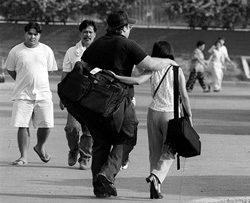 briskly,
holding hands, through the people to a waiting jeepney.
briskly,
holding hands, through the people to a waiting jeepney.
Four days later, they got married at Manila City Hall. Sikes did not want anyone talking him out of it.
During their honeymoon at a $30-a-night hotel room in central Manila, the young bride struggled with her English to explain why she loved Sikes.
"He's very handsome," she said, leaning against her 285-pound
husband on the hotel bed. 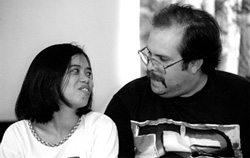
Asked what they had in common, at first she said "nothing." Then Sikes wrote out some suggestions in a notebook and she nodded: They both like movies, reading and music.
"I don't want somebody who's going to beat me over the head with women's rights and equality," Sikes said. "I kind of think this marriage will be as it was in the United States 40 or 50 years ago, when the husband's decision was the final word."
Asked to explain who will be the boss, Arlene answers simply.
"First Andrew," she said. "Second me."