 Written by M.E. Sprengelmeyer, staff writer
Staff photos by Juan Carlo
Clinic addresses high disease risk for prostitutes
ANGELES CITY, The Philippines -- Voices echo through the lobby
of a plain, white building as hundreds of rail-thin women jockey for position
in line. 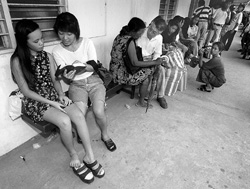
It's Wednesday morning at the Angeles City Social Hygiene Clinic, time for the regular weekly health checkups for some of the city's registered prostitutes.
A local missionary works the crowd, preaching the gospel as a way out of the lifestyle. In a nearby office, physician Teresita Esguerra sits at her desk with a pile of paperwork.
The city of 276,000 people -- roughly the size of Ventura and Oxnard combined -- has 1,000 registered prostitutes, and others who don't register.
Esguerra says one in 25 of them has syphilis, another 1.5 percent have gonorrhea and even more have the infection urethritis. Since 1985, 40 local prostitutes have tested positive for HIV, the virus that causes AIDS.
Esguerra thinks the numbers are pretty good, considering the local health authorities have far less control over the men who seek prostitutes now that nearby Clark Air Base is closed.
In the old days, she said, American airmen carrying diseases underwent regular health checkups and could be quarantined on base.
Today, the soldiers have been replaced in the nightclubs on Fields Avenue with a new breed of sex tourists: Americans, Australians, Swedes, Germans and Britons.
"The problem is we cannot screen everyone who's coming and getting into the country at the airport," Esguerra said.
According to the group MAP Network, which monitors the spread of AIDS, the Philippines has a relatively low transmission rate for the disease. The statistics are slowly increasing because of high-risk heterosexual behavior.
The Philippine government estimates there are about 23,000 people infected with HIV and that it could increase to 38,000 by the year 2000.
To Esguerra, what is scary is that sex tourists in places like Angeles City often refuse to use condoms and sometimes engage in riskier sexual behavior than they might in their home countries.
A local physician has told Esguerra he is treating an HIV-positive man who frequents prostitutes. Privacy laws in the Philippines prevent him from doing anything about it, she said.
"It's too risky, but still they do it," Esguerra said. "They know the risk they're getting into, but there's no prevention on their part."
Many of the prostitutes in Angeles City come from rural areas, and poverty makes it difficult to talk women into giving up prostitution.
In line at the health clinic, 18-year-old dancer Anna Marie Sugala said she is thinking about leaving the job.
"Maybe this week I stop, only because I'm tired of dancing every night," Sugala said. "I want to go back to school. Maybe I study to be a nurse."
"My auntie said I should go to work in the bar," she said. "Every month I send to my parents 5,000 pesos ($125)."
For women without much education, that is far more money than they could earn in jobs outside the bars, Esguerra said.
"If through education we can put into their mind to change their job it's much better," Esguerra said. "But most of these girls come from out in the provinces, have no education and need to support their families."